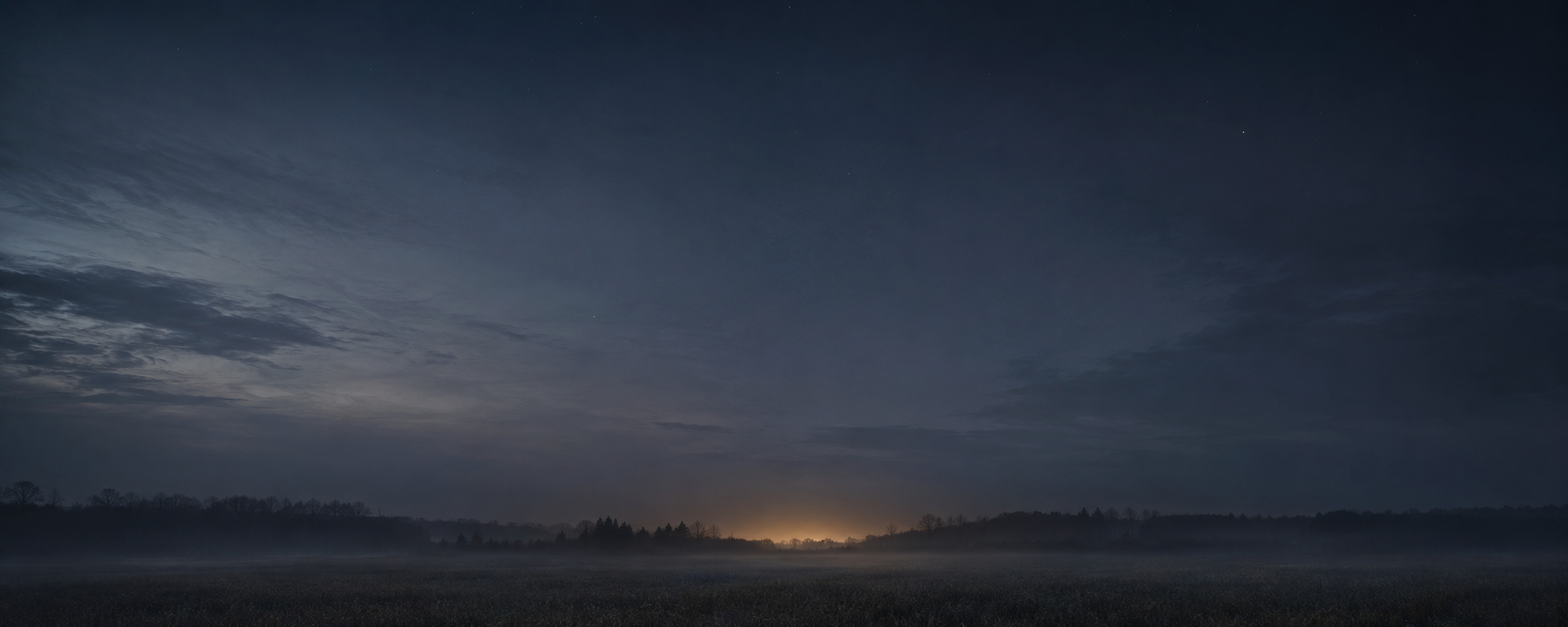
‘Ghost Stories for the Dead’: An overlooked Thomas Ligotti classic

One of Thomas Ligotti’s best stories doesn’t appear in any of his books. “Ghost Stories for the Dead” was first published in 1982 in the second issue of author/editor Thomas Wiloch’s small press horror magazine Grimoire. It was republished a few years later in Crypt of Cthulhu and then at Thomas Ligotti Online in the late 1990s. After that, it basically disappeared.

I find this mystifying, because if I were to assemble a list of my eight or ten favorite Ligotti stories, this would be among them. “Ghost Stories for the Dead” is a dark and reflective piece, partly mournful and partly horrific, about the bliss of nonexistence as contrasted with the nightmarish agony of existence. Ligotti contrasts the torments and absurdities of embodied existence with a strange, almost beatific condition of post-existence, where identity, memory, and suffering fall away into a state of absolute negation. But in the end, the story suggests that even this annihilating escape may not be secure.

In January, Chiroptera Press, which has published several gorgeous editions of Ligotti’s work, announced that they’re planning to publish a new collection later this year to be titled Thomas Ligotti, Menagerie: Uncollected Early Stuff. One hopes that as details emerge about this welcome development, “Ghost Stories for the Dead” will be listed among the book’s contents.

For a fuller reflection on this story, see “The Best Thomas Ligotti Story You’ve Probably Never Read,” in my Living Dark newsletter. It includes a link to read the story itself, along with an accompanying reflection on Ligotti’s rise to mainstream literary notoriety after years as a cherished cult author, as well as a brief account of how my own authorial beginnings were bound up with Thomas Ligotti Online and my deep response to his work.

The creative ebb and flow of writing

  • Post category:Creativity
  • Reading time:1 min read

Some of my most unexpected writing, the stuff that arrives with power, flow, and inspiration, has come after a few days or weeks when I have felt deeply deadened and bereft, as if abandoned by the creative spirit. This creative ebb and flow is distinct and repetitive enough across the years to constitute a pattern, and one that I can’t help but find striking and worth mulling over.

It’s as if the times when I wonder whether I’ll ever write again, and even if I will ever want to write again, represent an inner ebb tide, with the water of the psyche receding in preparation for a tidal flow. The subjective, conscious experience of that ebbing is a feeling of being totally becalmed and even averse to action, especially creative action like putting words on paper or screen.

Eventually, if this lasts long enough, I just give up and accept that I will not be writing anymore. And then, without fail (or at least so far), writing happens again, and with intensity. Learning this cycle has been an ongoing discipline of self-discovery and self-acceptance as a being rooted in the creative action-and-retreat cycles of the cosmos itself.

The algorithm of experience

Everybody talks about “the algorithm” these days, the invisible principle, or rather the collective set of them, that governs what’s delivered in our daily, individual interactions with the interwebs. An enormous slice of what we see and hear every day, the content that fills the container of our experience, is determined by hidden code. But there’s a deeper layer to consider: what might be called the algorithm of experience itself.

This is a metaphor just waiting to be extracted. In an age when the notion of “the algorithm” has become iconic, rising from the level of a mere technical term to become a universal, zeitgeist-level principle suffused throughout the cultural aether, it’s interesting to remember and reflect on how reality at large is essentially the expression of an algorithm that’s perpetually serving up everything that arises. And by “reality” I mean our individual experience—what Peter Brown, the late nondual spiritual teacher, helpfully characterized as our “experiential field.” Because at root, for each of us, it means the same thing. Reality is what’s experienced, what shows up. It’s all that’s ever encountered or known. Even thoughts or speculations about what might lie beyond immediate experience are only ever known in and as immediate experience.

This algorithm of your experience—which, again, is synonymous with reality, the only reality you can ever know—is fine-tuned with sheer, perfect accuracy, better than any tech company could ever build into their social media feed, for giving precisely what’s needed, whatever it is that inevitably has to emerge. A perfectly calibrated experiential feed. How else could it be? How could anything arise that wasn’t “meant” to?

When the point hits home, it marks a significant and subversive shift in perspective.

Reading on paper vs. screen: Why I prefer the page

In an age of ubiquitous glowing screens filled with endless, scrolling seas of text and images, I find myself increasingly drawn to reading on paper vs. screen, and I relish the relatively old-fashioned experience of solitary, disconnected, page-based reading. I find that I read better in this form, with greater enjoyment and understanding. I love to immerse myself in a book, journal, story, article, or essay (or poem, play, etc.) in the relatively peaceful, focused realm of the offline and the analog, where I can become deeply and totally absorbed in private communion with the author and his or her vision.

This may, I suppose, be a function of my upbringing in the pre-internet era, when all reading was done on paper. I didn’t acquire my first computer, an Apple IIe, until I was 14 years old, and the idea of reading a book on that green-lit screen was unthinkable (though I did read a ton of words on it while playing text-based fantasy games like Wizardry). The internet didn’t enter my world until I was in my mid-twenties, when the World Wide Web became publicly available, and by that time my set point as a reader was essentially established.

Though it took me some time to recognize the differences between online and page-based reading, I eventually came to understand that my preference for reading on paper vs. screen is rooted in something deeper: I crave text that is static and set, not fluid and reflowing. I want to read words that are carefully laid out on stable pages instead of ones that shimmer and shift like quicksilver, or like Proteus morphing under my hands into endlessly shifting shapes.

Such text, it turns out—the stable, set kind, I mean—forms an automatic aid to mapping and remembering what I have read. It provides something I can return to, reference, and use as a scaffolding for knowledge, memory, and appreciation. I can’t tell you how many important paragraphs and passages in my personal library of life-changing books I can still map in memory to their physical positioning on the page where I first encountered them and underlined or annotated them by hand. Additionally, text like this, deliberately laid out on pages with care for arrangement, appearance, and the coherence of these qualities with the actual content of the words, is much more amenable to that deep immersion. You can lose yourself in it.

For more on this theme, see my Living Dark essay, “Introducing the Living Dark Reader,” where I explore this approach to reading and the idea of curating a personal, slow-reading digital magazine.

Against personal branding

  • Post category:Creativity
  • Reading time:2 mins read

I couldn’t care less whether anything that I publish here or anywhere else is “on brand.” What does that even mean? Aside from the troubling (and faintly ridiculous) livestock connotations of the term “brand” to begin with, what is my personal signal or signature anyway? It’s precisely whatever interests me and wants to come through me in this moment, without fundamental regard for its fortunes or reception. In this sense, on this level, I am ardently and fundamentally against personal branding, or more specifically, on burning up much or any of my precious creative energy on it.

Well-crafted communiques tuned for clarity of expression in the context of the total rhetorical moment—yes.

Manipulative, extractive attempts to maximize some preselected outcome based on egoic notions of success—no.

The inbuilt serendipity of this dream of me-plus-world will serve as a kind of synchronicity machine, making the right connections manifest. All I have to do is show up and cooperate with what happens to be my deepest identity and impulse in the first place. Any apparent “effects” are really just side effects—things to observe and enjoy along the way without grasping at them, assigning them presupposed value, or turning them into a programmatic goal aimed at controlling how they land and what they do or don’t accomplish in rounding out some image of me in my own or anyone else’s mind.

Perhaps needless to say, if you are a writer yourself, I recommend adopting a version of this same attitude, appropriately tuned and calibrated to your own sensibility. Branding as such is actually fine for practical purposes in the commercial arena. But its potential to breach its rightful limits and invade our core self-sense at the fundamental creative-motivational level is real, and also something we should seriously guard against. Your inner genius is too valuable to be sacrificed on the altar of marketing.

(For sage advice on finding the organic connection between your deep creativity and the matter of communicating your work to other people, see Dan Blank’s excellent book You Are the Gateway.)